giovedì 30 dicembre 2010

a do it yourself spaceship? http://bit.ly/gVh3PG for real: suborbital baloon you can build yourself to take pictures from way up high
mercoledì 29 dicembre 2010
http://ping.fm/cVd8E millions of stolen passwords leaked, recently. here's the analisys. most common password? 123456 :)
http://bit.ly/hQXw1P Santa Claus Brand book is wonderful: santaclaus brand marketing strategy. the "credibility" curve is pure genius
http://bit.ly/igClTQ creative applications: Strange Rain for iPad, suggestive, interactive rain on your screen, and stories
http://bit.ly/fefgM1 generative art book: each book is different as it includes images generated from software, then printed on demand
martedì 28 dicembre 2010
http://bit.ly/gZDZHx thousands of stories hidden in data: why do people move in/out of New York? interactive infoaesthetics
http://bit.ly/hyQydV from Open Knowledge Fundation: Exploring European Energy Data. infoaesthetics and research
martedì 7 dicembre 2010
domenica 21 novembre 2010
Who are they?
from REFF, RomaEuropa FakeFactory
REFF-faces? Who are they?


REFF-faces? Who are they?
REFF-Faces, RomaEuropa FakeFactory
REFF-Faces, RomaEuropa FakeFactory
REFF-Faces, RomaEuropa FakeFactory
REFF-Faces, RomaEuropa FakeFactory
REFF-Faces, RomaEuropa FakeFactory
REFF-Faces, RomaEuropa FakeFactory
REFF-Faces, RomaEuropa FakeFactory
REFF-Faces, RomaEuropa FakeFactory
REFF-Faces, RomaEuropa FakeFactory
REFF-Faces, RomaEuropa FakeFactory
REFF-Faces, RomaEuropa FakeFactory
REFF-Faces, RomaEuropa FakeFactory
REFF-Faces, RomaEuropa FakeFactory
REFF-Faces, RomaEuropa FakeFactory
REFF-Faces, RomaEuropa FakeFactory
Who are they?
from REFF, RomaEuropa FakeFactory
REFF-faces? Who are they?
REFF-faces? Who are they?
REFF RomaEuropa FakeFactory

REFF-Faces, RomaEuropa FakeFactory

REFF-Faces, RomaEuropa FakeFactory

REFF-Faces, RomaEuropa FakeFactory

REFF-Faces, RomaEuropa FakeFactory

REFF-Faces, RomaEuropa FakeFactory

REFF-Faces, RomaEuropa FakeFactory

REFF-Faces, RomaEuropa FakeFactory

REFF-Faces, RomaEuropa FakeFactory

REFF-Faces, RomaEuropa FakeFactory

REFF-Faces, RomaEuropa FakeFactory

REFF-Faces, RomaEuropa FakeFactory

REFF-Faces, RomaEuropa FakeFactory

REFF-Faces, RomaEuropa FakeFactory

REFF-Faces, RomaEuropa FakeFactory

REFF-Faces, RomaEuropa FakeFactory

sabato 20 novembre 2010
venerdì 19 novembre 2010
giovedì 18 novembre 2010
mercoledì 17 novembre 2010
REFF RomaEuropa FakeFactory on La Stampa
RomaEuropa FakeFactory featured on La Stampa
A video about REFF RomaEuropa FakeFactory has been published on the website of La Stampa, an important italian newspaper.

REFF, RomaEuropa FakeFactory: next step
REFF RomaEuropa FakeFactory is back.
A book is coming out in Italy (and an international version is following soon, before the end of the year) together with the next step in our action in favor of better innovation policies andpractices for arts and culture.
During these days Italy is living strange times, with a government that is something that could easily be called a "soft dictatorship"and an extensive crisis scenario across culture, imaginaries and perspectives.
This, in particular, is a peculiar day for Italy, as the governmental crisis began just a few hours ago. And it is indeed a very strange crisis, as the in-crisis government actually has loads of power (it managed to have the crisis postponed by 14 days, to be able to create a few more laws:) ), and the possible alternatives do not really offer any real difference to the currently running models.
This is a media dictatorship, as its power is based on 20+ years of television and on the social changes it induced in the population.
Current culture and art policies reflect that. Totally.
This difficult scenario is what induced us in the first place when we created REFF, RomaEuropa FakeFactory.
A quick-quick history: in 2008 a big italian culture/arts institution created an international competition that was really terrible in terms of the supported cultural policies, of artists' rights and of intellectual property issues. We, a group of artists and activists together with 80+ partners all over the world , created REFF, a fake institution and a competition just like the "original" one, only supporting open, innovative practices and policies.
The impact was so strong that REFF was invited at the Cultural Commission of the Italian Senate.
The original institution (theFondazione RomaEuropa) was forced to change its policies and to transform its practices, becoming just like REFF :)
The action continued, as the original Fondazione became the focus of several large operators' assault on the digital imaginaries of people to create what they openly call the Digital Class.
This process saw the biggest italian telco operator (Telecom Italia) invading practically every space in digital arts, leading to a scenario in which even the absurd "Internet for Peace" campaign was possible: a telco operator was becoming a major political force in all the issues related to networks, digital innovation, intellectual property and publishing, obtaining the support of more that 70 representatives in both the Parlament and the Senate.
We leveraged REFF, our shadow institution, and uncovered many of these opaque processes. Last one of which is the assault on digital publishing industries: the market of ebooks and ebook readers is the latest area of assault on italy's digital cultures scenario and on the practices of free expression and self-determination.
This is why together with FakePress wecreated this book.Together with the book a software platform will be released (GPL2 license) allowing people to freely create ebooks, and enhanced books featuring augmented reality, wide tagging, and fruibility across several devices.
The platform has been recently presented at Artissima with the help of the Piemonte Share Festival as an opportunity for publishing and expression practices for the arts and culture.
Multiple events will follow in the next days and months.
Stay tuned, if you like.
cheers.
xDxD
A book is coming out in Italy (and an international version is following soon, before the end of the year) together with the next step in our action in favor of better innovation policies andpractices for arts and culture.
During these days Italy is living strange times, with a government that is something that could easily be called a "soft dictatorship"and an extensive crisis scenario across culture, imaginaries and perspectives.
This, in particular, is a peculiar day for Italy, as the governmental crisis began just a few hours ago. And it is indeed a very strange crisis, as the in-crisis government actually has loads of power (it managed to have the crisis postponed by 14 days, to be able to create a few more laws:) ), and the possible alternatives do not really offer any real difference to the currently running models.
This is a media dictatorship, as its power is based on 20+ years of television and on the social changes it induced in the population.
Current culture and art policies reflect that. Totally.
This difficult scenario is what induced us in the first place when we created REFF, RomaEuropa FakeFactory.
A quick-quick history: in 2008 a big italian culture/arts institution created an international competition that was really terrible in terms of the supported cultural policies, of artists' rights and of intellectual property issues. We, a group of artists and activists together with 80+ partners all over the world , created REFF, a fake institution and a competition just like the "original" one, only supporting open, innovative practices and policies.
The impact was so strong that REFF was invited at the Cultural Commission of the Italian Senate.
The original institution (theFondazione RomaEuropa) was forced to change its policies and to transform its practices, becoming just like REFF :)
The action continued, as the original Fondazione became the focus of several large operators' assault on the digital imaginaries of people to create what they openly call the Digital Class.
This process saw the biggest italian telco operator (Telecom Italia) invading practically every space in digital arts, leading to a scenario in which even the absurd "Internet for Peace" campaign was possible: a telco operator was becoming a major political force in all the issues related to networks, digital innovation, intellectual property and publishing, obtaining the support of more that 70 representatives in both the Parlament and the Senate.
We leveraged REFF, our shadow institution, and uncovered many of these opaque processes. Last one of which is the assault on digital publishing industries: the market of ebooks and ebook readers is the latest area of assault on italy's digital cultures scenario and on the practices of free expression and self-determination.
This is why together with FakePress wecreated this book.Together with the book a software platform will be released (GPL2 license) allowing people to freely create ebooks, and enhanced books featuring augmented reality, wide tagging, and fruibility across several devices.
The platform has been recently presented at Artissima with the help of the Piemonte Share Festival as an opportunity for publishing and expression practices for the arts and culture.
Multiple events will follow in the next days and months.
Stay tuned, if you like.
cheers.
xDxD
martedì 16 novembre 2010
lunedì 15 novembre 2010
giovedì 4 novembre 2010
REFF RomaEuropa FakeFactory stasera alle 21 su RaiNews24 per parlare del next-step dell'editoria http://bit.ly/9f28U8
mercoledì 3 novembre 2010
first ipad screenshots of the REFF RomaEuropa FakeFactory book http://bit.ly/cBmhve iPhone and other versions following soon
REFF RomaEuropa FakeFactory, iPad version
REFF RomaEuropa FakeFactory, iPad version
 REFF, RomaEuropa FakeFactory, iPad version
 the REFF Book is about to be published. In the meanwhile previews start to emerge on the web of the interfaces of its mobile versions. Here are the screenshots of the iPad version
REFF RomaEuropa FakeFactory at Artissima with Piemonte Share Festival http://bit.ly/cAak9o what can technologies do for art publishing?
REFF RomaEuropa FakeFactory: the Book. @ Share Festival / Artissima
REFF RomaEuropa FakeFactory: the Book. @ Share Festival / Artissima


REFF RomaEuropa FakeFactory the Book
Art is Open Source and FakePress will be launching the preview of the book “REFF RomaEuropa FakeFactory“, produced by DeriveApprodi and FakePress, at the Share Festival, in Turin, Italy.
On November 6th we will participate to the conference “Publishing Art 2.0: Next Step Publishing – New Scenarios of Art Publishing“ at Artissima.
Here is the link for the Facebook Event
Here is some info about the Piemonte Share Festival
Here is some info about FakePress
Here is some info about the REFF Book
Here is some info about DeriveApprodi
Here is some info about Artissima
martedì 26 ottobre 2010
REFF, RomaEuropa FakeFactory: critique, arts, culture, publishing and augmented reality http://ping.fm/eYfEc
domenica 24 ottobre 2010
FakePress indaga gli scenari post editoriali al festival della creatività di Firenze http://bit.ly/aBLWNx
REFF RomaEuropa FakeFactory al festival della creatività a Firenze http://bit.ly/aBLWNx cosa viene dopo l'iPad?
venerdì 22 ottobre 2010
giovedì 21 ottobre 2010
REFF, RomaEuropa FakeFactory: critique, arts, culture, publishing and augmented reality
from REFF RomaEuropa FakeFactory on AOS
info at REFF RomaEuropa FakeFactory
[caption id="attachment_1055" align="aligncenter" width="400" caption="REFF RomaEuropa FakeFactory"] [/caption]
[PRESS RELEASE - ENGLISH ]
Almost two years after its creation il 2009, the REFF - RomaEuropa FakeFactory is back with the publication of its book, published in Italy by DeriveApprodi & FakePress:
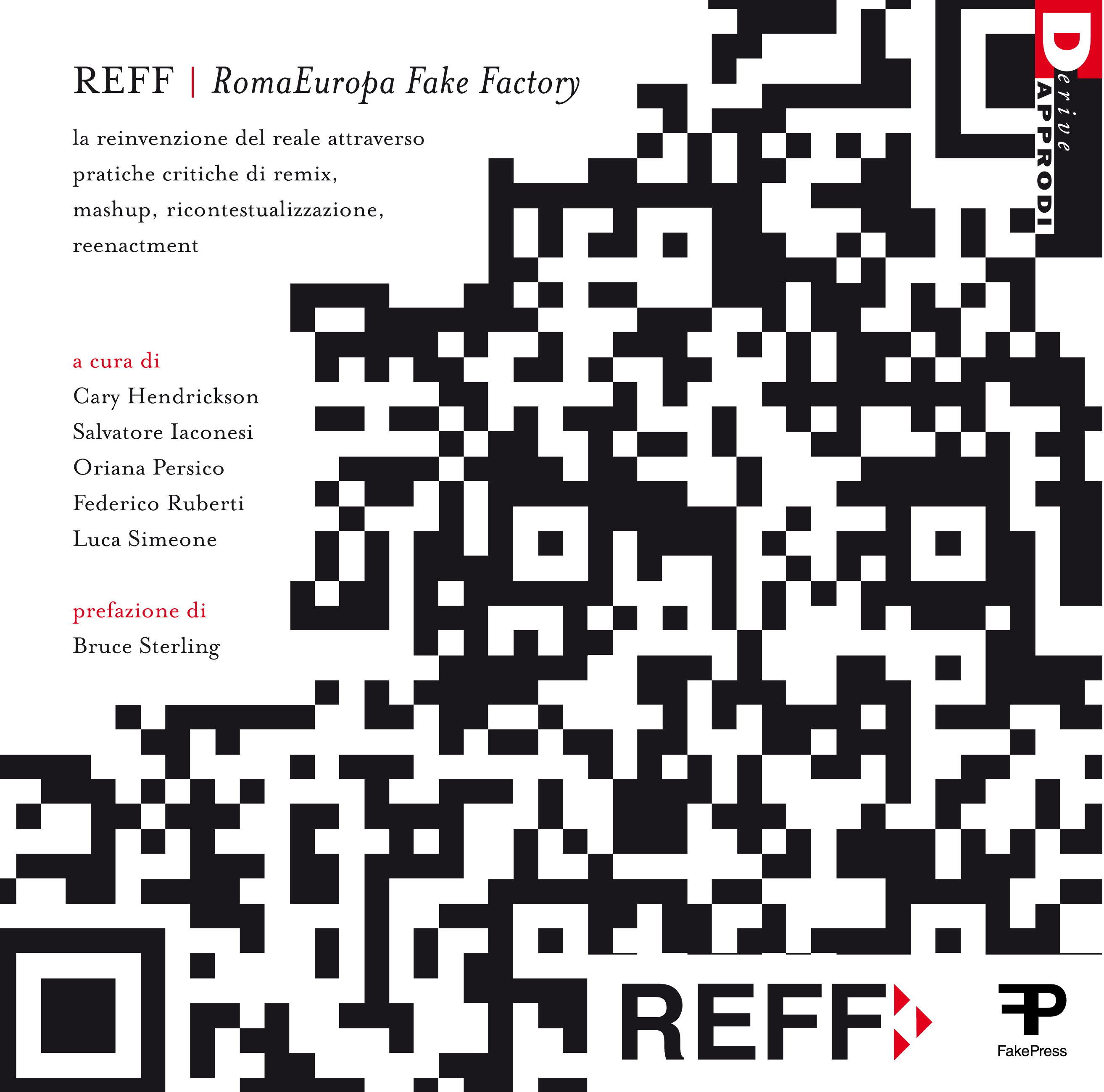
[caption id="attachment_1056" align="aligncenter" width="400" caption="REFF RomaEuropa FakeFactory cover"] [/caption]
REFF
The reinvention of the real through critical practices
of remix, mash-up, re-contextualization, reenactment
Foreword by: Bruce Sterling
Over 30 contributions ranging from critical articles to interviews; a catalog of 30 works exploring the themes of remix in an extended way; the special mentions of the 2009-2010 contest; a new experience of reading integrating the digital and paper dimentions trough the use of Augmented Reality and tagging; an open source tool for creating ubiquitous, cross-media publications, by FakePress.
From the foreword, by Bruce Sterling:
"Right now, the behaviors and activities commemorated in this book are bizarre. Very. They are so peculiar that they are inherently difficult to describe, because they come from the outer reaches of an emergent network-culture.
I could write an entire book about these ideas and practices, a book that would be science fiction, architecture fiction, design fiction, a technical manual and also a manifesto for network economics. That book would be rather like this book, only less entertaining."
REFF. An example of an artistic, cultural and political act. A truly Augmented Reality, a multi-strata object that entices to be discovered, read and used with more “sense” up to the performative one. A new prototype of publication, beyond the e-book.
Copyright
RomaEuropaFakeFactory book is licensed under Creative Commons Attribution-NonCommercial ShareAlike 2.5 Italy.
Site
http://www.romaeuropa.org
http://www.fakepress.it
http://www.deriveapprodi.org
Facebook
http://www.facebook.com/pages/REFF-RomaEuropa-FakeFactory/121217751261830?ref=ts&v=wall
Press & Contacts
Davide Sacco - Ufficio Stampa DeriveApprodi
ufficiostampa@deriveapprodi.org
+39 328 3921381
+39 392 3273987
Oriana Persico - Media & Communication FakePress
oriana@fakepress.net
+39 347 7126928
AUTHORS, ARTISTS & CURATORS
(in alphabetical order)
"VOICES"
Richard Barbrook, Tatiana Bazzichelli, Germana Berlantini, Mike Bonanno, Loretta Borrelli, Andy Cameron, Massimo Canevacci, Francesca Canu, Carlo Cappa, Antonio Caronia, Dario Carrera, Stefano Coletto, Fiorello Cortiana, Umberto Croppi, Marco Fagotti, Marc Garret, Alex Giordano, Maria Hellström Reimer e Milica Lapčević, Lorenzo Imbesi, Stephen Kovats, Simona Lodi, Francesco "Warbear" Macarone Palmieri, Federico Monaco, Movimento ScambioEtico, Andrea Natella, Eleonora Oreggia aka xname, Luigi Pagliarini, Federico Ruberti, Marco Scialdone, Guido Scorza, Valentina Tanni, Jasmina Tescnovic, Cristina Trivellin e Martina Coletti
"VISIONS"
0100101110101101.ORG, Antoni Abad, Alterazioni Video, Apparati Effimeri, David Benqué, Jens Brand, Alex Dragulescu, Amy Francescini (Future Farmers), Flyer Communication (FLxER), Derek Holzer, Carlo Infante, jodi.org, Steve Lambert, Les Liens Invisibles, Fosco Loiti Celant, Garrett Lynch, Guthrie Lonergan, Quayola, Rebar Group, Ben Rubin, Adam Somlai-Fischer (Architecture), Sosolimited, Eugenio Tisselli, Troika, Hannes Walter e Stephen Williams (Fluid Forms), Marianne Weems (The Builders Association), Clemens Weisshaar e Reed Kram, Jaka Železnikar
" REFF Special Mentions 2009/2010"
Daniele Mancini / Urban Fields, Agnese Trocchi, Mathilde Neri Poirier / Hotel Nuclear, Luther Blissett, Agatino Rizzo / Cityleft, Adriano Sanna / Image Hunters, Pasquale de Sensi, Paola Zampa, Michael Cipolla, Chiara Passa, Anna Olmo, Eva Pedroni Simoncelli, Francesco D'Isa, Marco Pignatti, Samo Pedersen, Anna Gramma, Ivan / Eri Nav, Nanette Wylde, Laura Spampinato, Alessandro Suizzo, Chiara Micheli, Andrea Paglia, Difesa Jubecca, Andreas Maria Jacobs, Leif Ahnland, Stefano Pala e Francesco Rosati, Alessio Ballerini, Gregor Rozanski, quwt, judsoN, Bernardina / Demo Architects, Jelena Jovic, Sara Basili, Juan Lopez, Jimenez Lai, mag.MA Architetture, moriyuki, Giorgia Borroni, Cortomobile, Cenk Dereli, Titusz Tarnai, Daniele Salvatori, Chiara Angioli, Luis Rolando Rojas, Yurij Alekhno, Jose Antonio De Jesus Corona Gonzalez, Snak3, Adriana e Morena, Sheriff Xenoph, Pier Giorgio De Pinto
Edited by:
Cary Hendrickson, Salvatore Iaconesi, Oriana Persico, Federico Ruberti, Luca Simeone (FakePress)
http://www.romaeuropa.org
Available in the best bookstores from November 2010
info at REFF RomaEuropa FakeFactory
[caption id="attachment_1055" align="aligncenter" width="400" caption="REFF RomaEuropa FakeFactory"]
 [/caption]
[PRESS RELEASE - ENGLISH ]
Almost two years after its creation il 2009, the REFF - RomaEuropa FakeFactory is back with the publication of its book, published in Italy by DeriveApprodi & FakePress:
[caption id="attachment_1056" align="aligncenter" width="400" caption="REFF RomaEuropa FakeFactory cover"]
 [/caption]
REFF
The reinvention of the real through critical practices
of remix, mash-up, re-contextualization, reenactment
Foreword by: Bruce Sterling
Over 30 contributions ranging from critical articles to interviews; a catalog of 30 works exploring the themes of remix in an extended way; the special mentions of the 2009-2010 contest; a new experience of reading integrating the digital and paper dimentions trough the use of Augmented Reality and tagging; an open source tool for creating ubiquitous, cross-media publications, by FakePress.
From the foreword, by Bruce Sterling:
"Right now, the behaviors and activities commemorated in this book are bizarre. Very. They are so peculiar that they are inherently difficult to describe, because they come from the outer reaches of an emergent network-culture.
I could write an entire book about these ideas and practices, a book that would be science fiction, architecture fiction, design fiction, a technical manual and also a manifesto for network economics. That book would be rather like this book, only less entertaining."
REFF. An example of an artistic, cultural and political act. A truly Augmented Reality, a multi-strata object that entices to be discovered, read and used with more “sense” up to the performative one. A new prototype of publication, beyond the e-book.
Copyright
RomaEuropaFakeFactory book is licensed under Creative Commons Attribution-NonCommercial ShareAlike 2.5 Italy.
Site
http://www.romaeuropa.org
http://www.fakepress.it
http://www.deriveapprodi.org
http://www.facebook.com/pages/REFF-RomaEuropa-FakeFactory/121217751261830?ref=ts&v=wall
Press & Contacts
Davide Sacco - Ufficio Stampa DeriveApprodi
ufficiostampa@deriveapprodi.org
+39 328 3921381
+39 392 3273987
Oriana Persico - Media & Communication FakePress
oriana@fakepress.net
+39 347 7126928
AUTHORS, ARTISTS & CURATORS
(in alphabetical order)
"VOICES"
Richard Barbrook, Tatiana Bazzichelli, Germana Berlantini, Mike Bonanno, Loretta Borrelli, Andy Cameron, Massimo Canevacci, Francesca Canu, Carlo Cappa, Antonio Caronia, Dario Carrera, Stefano Coletto, Fiorello Cortiana, Umberto Croppi, Marco Fagotti, Marc Garret, Alex Giordano, Maria Hellström Reimer e Milica Lapčević, Lorenzo Imbesi, Stephen Kovats, Simona Lodi, Francesco "Warbear" Macarone Palmieri, Federico Monaco, Movimento ScambioEtico, Andrea Natella, Eleonora Oreggia aka xname, Luigi Pagliarini, Federico Ruberti, Marco Scialdone, Guido Scorza, Valentina Tanni, Jasmina Tescnovic, Cristina Trivellin e Martina Coletti
"VISIONS"
0100101110101101.ORG, Antoni Abad, Alterazioni Video, Apparati Effimeri, David Benqué, Jens Brand, Alex Dragulescu, Amy Francescini (Future Farmers), Flyer Communication (FLxER), Derek Holzer, Carlo Infante, jodi.org, Steve Lambert, Les Liens Invisibles, Fosco Loiti Celant, Garrett Lynch, Guthrie Lonergan, Quayola, Rebar Group, Ben Rubin, Adam Somlai-Fischer (Architecture), Sosolimited, Eugenio Tisselli, Troika, Hannes Walter e Stephen Williams (Fluid Forms), Marianne Weems (The Builders Association), Clemens Weisshaar e Reed Kram, Jaka Železnikar
" REFF Special Mentions 2009/2010"
Daniele Mancini / Urban Fields, Agnese Trocchi, Mathilde Neri Poirier / Hotel Nuclear, Luther Blissett, Agatino Rizzo / Cityleft, Adriano Sanna / Image Hunters, Pasquale de Sensi, Paola Zampa, Michael Cipolla, Chiara Passa, Anna Olmo, Eva Pedroni Simoncelli, Francesco D'Isa, Marco Pignatti, Samo Pedersen, Anna Gramma, Ivan / Eri Nav, Nanette Wylde, Laura Spampinato, Alessandro Suizzo, Chiara Micheli, Andrea Paglia, Difesa Jubecca, Andreas Maria Jacobs, Leif Ahnland, Stefano Pala e Francesco Rosati, Alessio Ballerini, Gregor Rozanski, quwt, judsoN, Bernardina / Demo Architects, Jelena Jovic, Sara Basili, Juan Lopez, Jimenez Lai, mag.MA Architetture, moriyuki, Giorgia Borroni, Cortomobile, Cenk Dereli, Titusz Tarnai, Daniele Salvatori, Chiara Angioli, Luis Rolando Rojas, Yurij Alekhno, Jose Antonio De Jesus Corona Gonzalez, Snak3, Adriana e Morena, Sheriff Xenoph, Pier Giorgio De Pinto
Edited by:
Cary Hendrickson, Salvatore Iaconesi, Oriana Persico, Federico Ruberti, Luca Simeone (FakePress)
http://www.romaeuropa.org
Available in the best bookstores from November 2010
ESA Conference 2010 Bocconi FakePress,Ubiquitous Anthropology,NeRVi NeoRealismo Virtuale,#REFF RomaEuropa FakeFactory http://bit.ly/b4T3tv
ESA Conference 2010 @ Bocconi University
[caption id="attachment_1051" align="aligncenter" width="400" caption="ESAConference"] [/caption]
We have recently been at the ESA Conference 2010 "Culture and the Making of Worlds" held at the Bocconi University in Milan during October 2010.
The conference is one of the main events in the global research scenario of sociology. It is held by the European Sociological Association (ESA) and the conference was organized by the ASK group at the Bocconi University.
With FakePress we presented a series of projects.
First we made a general presentation of the FakePress project
Then we presented the Squatting Supermarkets project:
then we presented our anthropologi writing project Ubiquitous Anthropology / Ubiquitous Bororo:
and the second part
and then we presented the REFF RomaEuropa FakeFactory project / action
and, by the way, check out often on the REFF RomaEuropa FakeFactory page, as a wonderful book is coming out using augmented reality and wide tagging techniques published by DeriveApprodi and FakePress.
All our contributions have been published here on the SSRN (Social Science Research Network).
In the next few days we will publish all the presenttions and PDFs of the presentations.
 [/caption]
We have recently been at the ESA Conference 2010 "Culture and the Making of Worlds" held at the Bocconi University in Milan during October 2010.
The conference is one of the main events in the global research scenario of sociology. It is held by the European Sociological Association (ESA) and the conference was organized by the ASK group at the Bocconi University.
With FakePress we presented a series of projects.
First we made a general presentation of the FakePress project
Then we presented the Squatting Supermarkets project:
then we presented our anthropologi writing project Ubiquitous Anthropology / Ubiquitous Bororo:
and the second part
and then we presented the REFF RomaEuropa FakeFactory project / action
and, by the way, check out often on the REFF RomaEuropa FakeFactory page, as a wonderful book is coming out using augmented reality and wide tagging techniques published by DeriveApprodi and FakePress.
All our contributions have been published here on the SSRN (Social Science Research Network).
In the next few days we will publish all the presenttions and PDFs of the presentations.
domenica 10 ottobre 2010
mercoledì 6 ottobre 2010
workshop new media book: Call for action! http://on.fb.me/cPXvB9 diteci il vostro next-step publishing
lunedì 27 settembre 2010
New Media Book: in Milan presenting the next step of cross media publishing http://bit.ly/a73XZq ebook augmented reality fakepress
New Media Book: a workshop on the next-steps of publishing
New Media Book: a workshop on the next-steps of publishing



New Media Book
FakePress and Art is Open Source will present a workshop titled
“Next-step publishing: ubiquitous, disseminated, emergent, multi author narratives”
[program and info at the bottom of the article]
We can transform any space or surface into a display using electronic devices combined with location-based technologies, sensors, augmented reality and innovative visual surfaces. Furthermore, interactive surfaces are transforming the world, people and their activities.
It is progressively more possible – and accessible – to “write on the world“, layering contents, meanings, visuals and sensations that anyone can compose, diffuse and communicate.
The world transforms into a cross-medial polyphony built from ubiquitously accessible points of view: augmented reality, QRCodes, spime, fiducial markers, wearable technologies, portable electronic devices allow accessing content and information, and interacting with them directly from places, architectures, objects and bodies.
All this brings the word “publishing” into a totally new perspective, deeply mutating all of the roles involved: editors, authors, audiences, critics, curators. Roles that remix just as the visions and the contents, mutually interconnecting and overwriting each other, creating multiple and fluid visions of the world whose adoption can be a key element to the creation of new forms of expression, new sensibilities, new spaces.
The availability of ways to effectively stratify interpretations on the world in autonomous and incontrollable modalities gives rise to infinite possibilities for self-expression, self-determination and for the creation of sustainable opportunities which we have a chance to catch. Doing it effectively is a linguistic act and a cultural process which we can only activate through the emergence of imaginaries that allow for creation of these autonomous realities, their integration in the flow of our daily lives and the escape from those “walled gardens”, dead ends and mouse-traps that constantly sit around the corners of technological adoption.
During the workshop we will present these concepts throughout the disciplines and practices of art design and communication sciences, of digital and visual cultures, of hacking and activism.
Theory will go side by side with practice: we will introduce our newly developed Open Source platform that will be released by november under a GPL2 license, through which any WordPress blog can be transformed into a multichannel publishing system with cross-medial features (web, mobile, paper, augmented reality, location based, digital book…).
We will then show, in practice and getting people involved, how it is possible to use the platform to create a cross-medial publication that is accessible geographically, in proximity, architecturally, from objects “filled” with content and information, in augmented reality, from mobile phones, tablets and computers, and also from paper publications.
For anyone attending: please bring your laptop. The workshop will be useful even if you don’t bring your laptop with you, but you’ll have a chance to create your own example publication if you do bring it.
An event inside Innovation Festival 2010 – www.innovationfestival.it
Innovation Festival
NEW MEDIA BOOK
CONFERENCE + WORKSHOP
curated by
Milano in digitale
Cristina Trivellin e Martina Coletti
Fondazione D’Ars Oscar Signorini onlus, Milan
October 9th 2010 – 14:00 / 19:00
Palazzo Affari ai Giureconsulti, piazza Mercanti 2, Milano
14:00-16:30 workshop
“Next-step publishing: ubiquitous, disseminated, emergent, multi-author narratives”
Salvatore Iaconesi/xDxD.vs.xDxD e Oriana Persico/penelope.di.pixel
FakePress http://www.fakepress.it/
16:30 Conference with:
- Antonio Caronia, scientific curator of the initiative
- Mario Gerosa, curator, and Roberta Peveri coordinator of: Parla come navighi. Antologia della webletteratura italiana, Edizioni Il Foglio
- Alessandro Bertante, writer, curator of the anthology Voi non ci sarete. Cronache dalla fine del mondo, X book
- Marco Ghezzi, BookRepublic (http://blog.bookrepublic.it/)
Link to the Facebook event: http://www.facebook.com/event.php?eid=152666021423234
domenica 26 settembre 2010
Nadia, the camera that understands beauty http://bit.ly/aKGT6e camera does not show photos, but judges your shots
sabato 25 settembre 2010
html5 video demo by mozilla drumbeat http://bit.ly/ammp2R watch around the screen, as the video connects social networks, maps, data...
venerdì 24 settembre 2010
txt couture http://bit.ly/9qoVPd real models show your dresses. people control them using txt messages
urban remix http://bit.ly/akft4I mobile software to capture sounds of cities and recreate them into remixed localized soundscapes
Technological disobedience by Ernesto Oroza http://bit.ly/dAZoHN great book on Cuba as a case-study for creativity
mercoledì 22 settembre 2010
Massimo Canevacci: F for Fake http://bit.ly/c2oaSr new scenarios for cultures and innovation thenks to digital technologies reff romaeuropa
lunedì 20 settembre 2010
take 500thousand+ people on dating networks and try to understand what people like http://bit.ly/9f4GvC
http://bit.ly/cpHiLu beautiful infoaesthetic maps of where locals and tourists take pictures in various cities
wonderful! http://bit.ly/bHpH24 infoaesthetic maps show 40 cities with ethnic distributions. neighborhod self-definitions emerge
http://bit.ly/c0GMbd this post by frog interactive is almost a manual for software engineer/interaction designer collaboration
after TED http://bit.ly/a6W1rK the economist launches sereis of confereces. 1st: human potential. doubts on the phylosphical framework
Cities telling stories: Atlas, ConnectiCity, reality and a nice event
from http://www.artisopensource.net/2010/09/20/cities-telling-stories-atlas-connecticity-reality-and-a-nice-event/

Just back from the event held yesterday at the Circolo degli Artisti in Rome, called “Love and Kill Your Own Town”. The event was created by the guys and girls at CityVision Mag in the Wi-Fi Art series of events.

ConnectiCity, cities tell stories
The event featured an incredible set of international projects being showcased using the style called Pecha Kucha, with each presentation being shown using 20 slides automatically moving to the next one after 20 seconds. My personal favourites of the night were maO, featuring some interesting thoughts on interactivity and on letting people define the borders of spaces, Michael Caton, a young designer who presented a software/photography project showing the “backstage” of the colossal architectural building grounds in Dubai and the rough condition of their workers, Weekend in a Morning, who presented a beautifully surreal and poetic project in which the traffic situation in Rome was confronted by designing an air transportation system using hot-air balloons from the borders of the city, and 2A+P/A, with their wonderful project about the productive condos in which a housign system was integrated with facilities for urban gardening, energy production and all sorts of activities that implement a sustainable living scheme. But all the projects were really interesting in proposing views on the city that created alternative interpretations of given reality, discovering how architectures could describe new forms of life either by suggesting – through spaces, materials and what you can do with them – different ways of living – more sustainable, more sensible to people and the environment and, most of all, intriducing the possibility for people to decide what to do with their spaces – or by doing it first-hand, following processes in which human beings, their self determination and their expression, are the most valuable thing that is taken into account.
At the event we presented two things: a project featuring wide sensing techniques to publish the stories of cities, and what we called the Atlante di Roma.
The first: Cities tell stories
this are the presentation slides we used:
FakePress presents: Cities tell their stories and “a Fake Project”
View more presentations from salvatore iaconesi.
As you can see by following the slides we told the story of how we gave thousands of people electronic devices capable of generating info and bio feedback, and combining this information with other sources to generate visual narratives of the city.
We chose 3 persons among the thousands and we created a story. On each person’s callout you can see the red bar, showing heartbeat rate, the blue bar showing stress conditions as gathered from galvanic skin response feedback, and the green bar showing emotional arousal information as collected from the interface of a mobile application that was given to them together with the devices.
The story followed the life of the three characters, describing a little urban love story, in which the sensors, traffic conditions, CO2 production, and mobile traffic profile of the the characters effectively created a time-based infoaesthetic tale.
The project was fake.
Together with FakePress we did similar projects and many people all over the world are currently creating and researching on these themes, making them more and more actual and feasable every day. So the fact that we presented a fake project is not really a big deal :) (and, halfway through the presentation we actually told people, and justified using the argumentation that I will use in a coule of lines or so)
We presented a fake project because it was probabily more real than any project presentation that we could have made.
Project presentations can be done in several ways: be them poetic, minimalistic, corporate… But, mostly, they represent only a single point of view. A single, incomplete, point of view.
So they do not represent, in any way, reality (or, at least, some indefinable, absolute “thing” that some people may have the temptation to call “reality”) which is, by definition, an interactive cohexistence of multiple points of view.
So we decided that it would be more significative to tell a lie, to describe a fake project, but, while doing this, to describe our perspective on the world and to delegate the discussion of our peojects to the projects themselves, that can be experienced online, used on mobile phones and even worn, in the case of our wearable technologies.
The second thing that we did during the event was to present one of these projects, in total adherence to what we described in the fake project presented with the slideshows. So, after all, it was not a fake. or, better, the presentation was a fake that described a real thing, so that the real thing could be more understandable. And, actually, it was fantastic how people believed more in the fake than in my expanations of the real project presented, which I will give you all a few lines below.
the project was presented as Atlante di Roma, but, after the presentation, it should actually be called “ConnectiCity“.
Let’s see why.
Atlante di Roma was an extraordinary architectural installation that we have been invited to create by Paolo Valente, the curator, for the Index Urbis Festa dell’Architettura in Rome. The installation featured a large-scale urban screen (about 35 meters long) that enacted a series of generative interfaces through which the visions on the city produced by institutions, organizations, studios and single individuals could be navigated using multitouch technologies, across space, time and subjects. The installation was though as something that could remain persistent, with an information system feeding its information that in a first phase (the one for the event) would have been fed by the responsibles of the organizations involved, but that would have been opened to public access so that anyone could express their vision on the city by uploading text, multimedia and their own voices.
Apart from the ever-present technical problems and some adjustments and changes in the interactivity that, after seeing it in action, we all agreed, together with Paolo, were needed, the Atlas perfectly did its job. And the online version is still working (if quite unattended, while we gather our forces and funds to keep the project going), and ready to be reproduced here in Rome and in other parts of the world.
What we presented at the event was something different.
You can see a scaled down version of the software used for the installation here at ConnectiCity: the City tells its stories
The concept shows a prottype for an urban screen that collects in realtime all the information generated by citizens on social networks and discussing their city, radiating outward from its geographical position. Imagine the screen placed in a neighborhood: walking by, you would could read what the people there, in that instant are saying about their city.
It is a way to communicate the multiple perspectives that effectively build the city, creating an architecture on top of it made from emotion, imagination, desires, ambitions and fears, and to make them part of the architectural landscape.
We decided to call this new concept using another name: ConnectiCity.
Atlas and ConnectiCity are two different things, thay have different objectives: the Atlas is a system that allows to create an environment with a specific form that is used to represent the visions on the city in which it is placed (as the Atlas of Rome does for Rome); ConnectiCity is a stream of consciusness, a situated collective stream of ideas, projects, visions and emotions emerging in a specific area thanks to whoever decides to express. While the Atlas focuses on the creation of a form, ConnectiCity focuses on the creation of a process.
Both share a vision: to create architectural spaces in cities that are dedicated to expression, emotion, and self-determination, tolerance, multi-culturalism.
domenica 19 settembre 2010
more on Ushahidi http://bit.ly/bDOVpY platform for sharing information in realtime for crisis response
http://bit.ly/cG2fv0 what is Ushahidi? global opensource social platform for people sharing realtime information during emergencies
martedì 14 settembre 2010
sabato 11 settembre 2010
venerdì 10 settembre 2010
giovedì 9 settembre 2010
on the Death of the Web
on the Death of the Web, Adam Richardson (frog design) keynote
http://ping.fm/e7Ls5
"Where this leads, Anderson and Wolff argue, is a recentralization of power back into the hands of large conglomerates - the ones who can aggregate the audiences, and create the large multi-screen, multi-device ecosystems to keep them engaged."
http://ping.fm/e7Ls5
"Where this leads, Anderson and Wolff argue, is a recentralization of power back into the hands of large conglomerates - the ones who can aggregate the audiences, and create the large multi-screen, multi-device ecosystems to keep them engaged."
Army Anthropologist?s Controversial Culture Clash
"Traditionally, the military has relied almost solely on so-called hard sciences, like nuclear physics and chemistry. But as a simple regime-change operation in Iraq descended into a baffling counterinsurgency, it became clear that you can have the most advanced sensors, the toughest armor, the most precise GPS-guided munitions, but without any insight into the civilian population — or at least some sense of how they’ll react to your moves — your war effort is sunk."
on Wired http://ping.fm/arWLQ
on Wired http://ping.fm/arWLQ
US military controversial social science program
http://ping.fm/Z5Fz4
turning social science into military intelligence
http://ping.fm/Z5Fz4
turning social science into military intelligence
FakePress @ Circolo degli Artisti: CITYVISION and Wi-Fi Art, Rome, September 19th 2010 http://ping.fm/psJ6J
FakePress @ Circolo degli Artisti: CITYVISION and Wi-Fi Art, Rome, September 19th 2010

fakepress wit cityvision mag and wifi art, at circolo degli artisti
FakePress: the next step of publishing.
The book explodes, and in this explosion its pieces disseminate, creating a new form of expression, a new way of writing onto the world.
Not books anymore, at least not in the classical ordinary way. Books become disseminated narratives, ubiquitous contents, traversable, wearable, shareable, interactive, emergent, time-based, location-based, relation-based.
Wearable technologies, Ubiquitous publishing, Augmented Reality, multiple-author, open ended narratives.
FakePress will present new forms of urban interaction and of critical innovation at:
LOVE AND KILL YOUR OWN TOWN
Curated by
Francesco Lipari and Ottavio Cialone
September 19th 2010
CIRCOLO DEGLI ARTISTI
VIA CASILINA VECCHIA 42, ROME
http://www.cityvision-mag.com/
Love and Kill your own town: Facebook event
Press Release
Flyer
Poster
Please link back to: http://www.artisopensource.net/2010/09/09/fakepress-circolo-degli-artisti-cityvision-and-wi-fi-art-rome-september-19th-2010/
Squatting Supermarkets @ Robot Festival, Bologna

Robot Festival 2010, Bologna, Italy
Augmented Reality can create opportunities for critical reinvention of the world.
Squatting Supermarkets uses augmented reality to break open the codes of commercial communication on the products we use every day. By taking a picture with your mobile phone to the logo of a product, individuas can contribute to a global, disseminated relational discourse on ecology, sustainablity and social responsibility issues of the things we eat, wear and use every day.
The logo gets recognized with computer vision techniques and is used as a fiducial marker that can be used by the Squatting Supermarkets application to create a discussion space onto which people can write their thoughts and interact with other individuals and groups.
An interpretative layer on top of reality where we can express ourselves, bypassing communication control strategies enacted by corporations and governments. Augmented Reality as a new space for self-expression.
FakePress and Art is Open Source present:
Squatting Supermarkets @ RObot Festival 2010
from 15th to 18th September
Bologna, Italy
click here for more info about RobotFest 2010
click here for more info about Squatting Supermarkets
click here for even more info about Squatting Supermarkets
please link back to: http://www.artisopensource.net/2010/09/09/squatting-supermarkets-robot-festival-bologna/
venerdì 3 settembre 2010
Garrett Lynch, “Video Network #1: Dialogues”
from REFF, RomaEuropa FakeFactory
Video Network #1: Dialogues is a two channel networked video installation conceived and created by artists Garrett Lynch and Frédérique Santune. It is the first work employing a prototype video networking system that allows the creation of works which are cinematic in nature yet break away from fixed linear narratives to explore concepts such as montage, collage, mixing, rhythm, looping, non-linearity in combination with simple interactivity in real time.
The installations networking system employs a combination of reverse engineered inexpensive consumer electronics and custom hardware to enable devices such as DVD players, monitors, video cameras, projectors etc. to communicate, in effect network and influence each other.
Video Network #1: Dialogues specifically investigates ideas of exploration, mapping and translation.
From the author:
"Each artist conceived of an exploratory video of the locality of the other. Two separate video works based on ideas of place, appropriation, exploration, walking, performance, rhythm and opposites (or binary); male and female, Irish and French, night and day etc., were to be created in isolation. Within the installation these videos are connected to each other by the video networking system, playback of each video is controlled by the other based on rules / patterns defined within that work. While the video work is a playback of the audio-visual documentation of the original walking performance it also functions as a non-linear extension of that performance which explores the space/time of the media which contains it."
 Video Network #1: Dialogues
Video Network #1: Dialogues is a two channel networked video installation conceived and created by artists Garrett Lynch and Frédérique Santune. It is the first work employing a prototype video networking system that allows the creation of works which are cinematic in nature yet break away from fixed linear narratives to explore concepts such as montage, collage, mixing, rhythm, looping, non-linearity in combination with simple interactivity in real time.
The installations networking system employs a combination of reverse engineered inexpensive consumer electronics and custom hardware to enable devices such as DVD players, monitors, video cameras, projectors etc. to communicate, in effect network and influence each other.
Video Network #1: Dialogues specifically investigates ideas of exploration, mapping and translation.
From the author:
"Each artist conceived of an exploratory video of the locality of the other. Two separate video works based on ideas of place, appropriation, exploration, walking, performance, rhythm and opposites (or binary); male and female, Irish and French, night and day etc., were to be created in isolation. Within the installation these videos are connected to each other by the video networking system, playback of each video is controlled by the other based on rules / patterns defined within that work. While the video work is a playback of the audio-visual documentation of the original walking performance it also functions as a non-linear extension of that performance which explores the space/time of the media which contains it."
Video Network #1: Dialogues


Eugenio Tisselli, “MIDIPoet” and “Media Trash”
from REFF, RomaEuropa FakeFactory
Multiple levels: a freely available software, a manifest, a series of performances using recycled media and recontextualized and remediated literary clips. Effective and convincing example of the creative possibilities offered to contemporary arts by the practices of reuse and reinvention of contents. The two works by Tisselli fascinate for the literary approach. Far from the feasts of visuals, words have often acted as bridges between different domains, with architects inventing readable buildings, bodies that fill with words, dances that forward informatin and paintings that, having abandoned the canvas, start showing words and their revelations.
Here approach is visceral: the performer selects the text, disassembles it, destroys it and gives re-birtg to it in interactive, other, forms in which visual elements re-communicate in other conceptual places the content of the original text, accessing perception through different paths. Image and word are treated with the same methodology, connected to the possibilities of sharing, processing, representing and, specifically, interacting.
From the author:
"I invented MIDIPoet because I wanted to become a Text Jockey. Back in 1999, software for playing with texts and images in real time using MIDI messages was either expensive or very difficult to use and, in some cases, both things at once. Facing this scenario, I knew I had to develop my own tools.
MIDIPoet is an environment for the composition and performance of pieces in which texts and images can be controlled, altered and remixed in real time, using a computer keyboard or any MIDI device (musical instruments, sensors, etc). In its current version, which was released in 2002, MIDIPoet consists of two applications: MIDIPoet Composer and MIDIPoet Player. As their names suggest, Composer contains a set of tools for creating MIDIPoet pieces, and Player performs them. The MIDIPoet environment has its own programming language, made up from relatively complex text commands. In order to make things easier, (and allow other people to approach the tool with realtively little pain) MIDIPoet Composer offers a visual way of creating MIDIPoet pieces, so there is no need to write code."
Megafone
Midi Poet
Midi Poet
Multiple levels: a freely available software, a manifest, a series of performances using recycled media and recontextualized and remediated literary clips. Effective and convincing example of the creative possibilities offered to contemporary arts by the practices of reuse and reinvention of contents. The two works by Tisselli fascinate for the literary approach. Far from the feasts of visuals, words have often acted as bridges between different domains, with architects inventing readable buildings, bodies that fill with words, dances that forward informatin and paintings that, having abandoned the canvas, start showing words and their revelations.
Here approach is visceral: the performer selects the text, disassembles it, destroys it and gives re-birtg to it in interactive, other, forms in which visual elements re-communicate in other conceptual places the content of the original text, accessing perception through different paths. Image and word are treated with the same methodology, connected to the possibilities of sharing, processing, representing and, specifically, interacting.
From the author:
"I invented MIDIPoet because I wanted to become a Text Jockey. Back in 1999, software for playing with texts and images in real time using MIDI messages was either expensive or very difficult to use and, in some cases, both things at once. Facing this scenario, I knew I had to develop my own tools.
MIDIPoet is an environment for the composition and performance of pieces in which texts and images can be controlled, altered and remixed in real time, using a computer keyboard or any MIDI device (musical instruments, sensors, etc). In its current version, which was released in 2002, MIDIPoet consists of two applications: MIDIPoet Composer and MIDIPoet Player. As their names suggest, Composer contains a set of tools for creating MIDIPoet pieces, and Player performs them. The MIDIPoet environment has its own programming language, made up from relatively complex text commands. In order to make things easier, (and allow other people to approach the tool with realtively little pain) MIDIPoet Composer offers a visual way of creating MIDIPoet pieces, so there is no need to write code."
Megafone
Midi Poet
Midi Poet


Iscriviti a:
Post (Atom)